



news
Flying Shear Cut To Length Line VS Rotary Shear Cut To Length Line
May 20,2026

Choosing the right cut-to-length (CTL) line is a critical decision for any metal processing business. The shear is the heart of your line, determining its speed, precision, and the quality of your final product.
Today, we’re focusing on the two most common high-speed shearing technologies: Flying Shear and Rotary Shear. While both are designed to cut metal coils into sheets at high speeds, they operate on fundamentally different principles and are suited for different applications.
To help you decide which one fits your production needs, this article provides a detailed comparison between Flying Shear and Rotary Shear CTL lines.
- Flying Shear cut-to-length (CTL) line:A flying shear cut-to-length line is a high-speed coil processing system that cuts metal sheets without stopping the material feed. Unlike start-stop lines that pause for each cut, the flying shear travels with the moving strip, cuts on the fly, then returns to position for the next cycle. This continuous operation eliminates downtime, maximizes throughput, and is essential for high-volume production environments such as steel service centers, automotive blanking lines, and appliance manufacturing.
In a flying shear line, the metal strip runs continuously through the uncoiler, leveler, and feed section. The flying shear mechanism consists of a cutting carriage mounted on linear guides parallel to the material flow. Here is how the process works:
Continuous Feeding: The strip moves at a constant speed through the leveler and toward the shear section.
Acceleration & Synchronization: As the strip reaches the preset length, the flying shear carriage accelerates from its home position to match the exact linear velocity of the moving material.
Cutting in Motion: Once synchronized, the cutting blade (often a circular saw or guillotine) engages and severs the strip—without stopping or slowing the line.
Return & Reset: After the cut, the carriage decelerates and returns to the home position, ready for the next cycle.
This "cut-on-the-fly" capability is the key differentiator from traditional start-stop lines, where the material must pause for each cut, creating bottlenecks and requiring looping pits for material accumulation.

- Rotary Shear Cut-to-Length Line: A rotary shear cut-to-length line is a coil processing system that uses a rotating blade mechanism to cut metal sheet without stopping the material flow. Unlike start-stop lines that pause for each cut, rotary shear lines enable continuous, high-speed production, making them ideal for steel service centers, automotive blanking, and appliance manufacturing.
In a rotary shear line, the metal strip runs continuously through the leveler and into the shear section. The rotary shear mechanism consists of two cutting blades mounted on parallel shafts that rotate in opposite directions. As the strip reaches the preset length, the blades engage and cut the material in a scissor-like motion—without requiring the line to stop.Here is the advantages :
High Productivity
Continuous operation eliminates start-stop cycles, significantly increasing throughput. Rotary shear lines can double or triple production compared to traditional lines.
Excellent Cut Quality
The rotating blade motion provides clean, square cuts with minimal burr. Length tolerance of ±0.3mm ensures consistent sheet dimensions.
Space Efficiency
Unlike start-stop lines that require deep looping pits, modern rotary shear lines have a compact footprint and can be bolted directly to existing floor slabs without expensive foundations.
Surface Protection
Because the material does not stop and start, there is less risk of marking or scratching sensitive surfaces—critical for aluminum, coated, or light gauge materials.

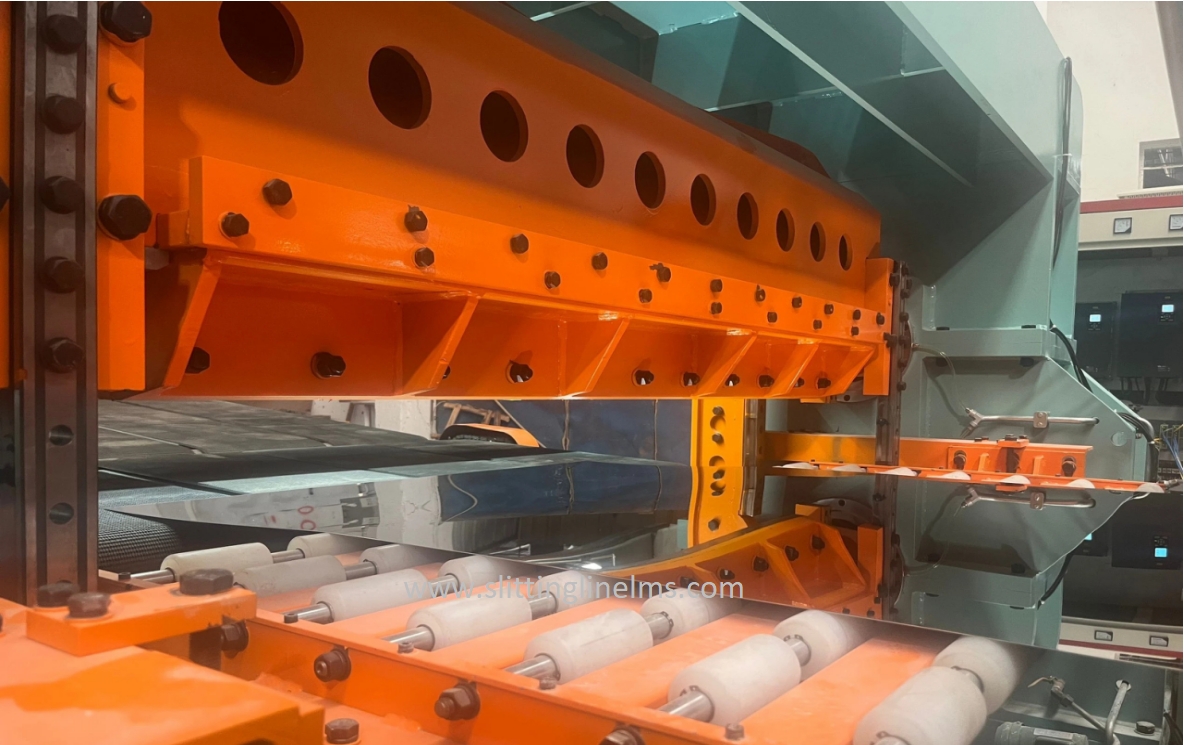
- Comparison: Rotary Shear vs. Flying Shear vs. Start-Stop
| Feature | Rotary Shear | Flying Shear | Start-Stop |
| Cutting Motion | Continuous | Continuous | Intermittent |
| Max Speed | Up to 90 m/min | Up to 50 m/min | Up to 40 m/min |
| Thickness Range | Thin | Light to Heavy | Light to Heavy |
| Looping Pit Required | No | No | Yes |
| Floor Space | Compact | Compact | Large |
| Best Application | Maximum throughput | Long metal sheet production | Common material |
PREVIOUS:
Recent News
Contact LMS
Contact Us
Fax:
+86-20-87319225
Tel:
E-mail:
E-mail:
Address:
20AB Zhongqiao Building,Guangzhou, China,510000
Request Quote
If you have found your desired products, please feel free to contact, we are here for you 24/7.
Contact
LMS is a metal coil slitting line manufacturer
info@slittinglinelms.com
20AB Zhongqiao Building,Guangzhou, China,510000
Other links
Legal Disclaimer
Privacy Policy
Cookie policy
Quik Links